
M.S Computer Science

B.S Computer Science

High School Diploma

Incoming Software Engineer Intern

LLM Engineer Intern
Optimizing LLM-based metadata extraction pipelines for UB-04 medical claim forms at ATOM Advantage's Record Ranger.
Undergraduate Researcher
Joining two research labs, excited to share what we work on!

AI / Document Intelligence Extern
- Ran retrieval experiments across embedding models (MiniLM/E5/BGE) and retriever settings (top-k, similarity thresholding, optional reranking), selecting a configuration that improved document-grounded QA on mortgage fee worksheets.
- Implemented hybrid ingestion (PyMuPDF text extraction + Tesseract OCR fallback) and validated OCR triggers using text-length heuristics to avoid unnecessary OCR on clean digital PDFs.
- Optimized chunking parameters (window size, overlap) to preserve contract clauses and fee tables, improving retrieval coherence and reducing context fragmentation.
- Added metadata tagging + filtering (doc_type, source_file, page/chunk IDs) to route queries and reduce noise during multi-PDF "blob" retrieval.
- Measured pipeline outputs (confidence, retrieved sources, latency, chunks-used) on a query test set and iteratively refined prompts and retrieval logic based on observed failure modes.
- Shipped an interactive Gradio chatbot wired to the full RAG backend (LlamaIndex + FAISS + llama.cpp LLMs) to demo and validate the system end-to-end.
Undergraduate Teaching Assistant - Calculus & Statistics
- Planned, organized, and led weekly peer-assisted study sessions for Calculus and Statistics courses, independently designing session structure, problem sets, and instructional strategies to reinforce core mathematical concepts and exam readiness.
- Proactively marketed and promoted sessions through campus outreach and peer networks, driving consistent attendance and engagement without direct faculty oversight.
- Facilitated large-group problem-solving discussions, breaking down complex concepts into clear, intuitive explanations that enabled students of varying backgrounds to reach understanding and apply techniques independently.
- Mentored students in independent learning strategies, emphasizing analytical thinking, self-debugging, and effective study methods rather than dependency on instructors or tutors.
- Built strong cross-year peer relationships, collaborating with upperclassmen and repeat attendees to foster a supportive learning environment and sustained academic progression.
- Earned 100% satisfaction ratings in anonymous student feedback surveys, with students citing leadership, clarity of instruction, and measurable improvement tied directly to session participation.

Tutoring Data & Systems Clerk
- Managed and organized student performance and attendance data to track tutoring progress, identify trends, and support data-driven instructional decisions across multiple students.
- Designed and maintained streamlined data-tracking processes for recording outcomes, improving consistency, accuracy, and ease of analysis for tutors and administrators.
- Supported mentorship and tutoring initiatives by working directly with younger students, building strong relationships that encouraged engagement, confidence, and long-term academic growth.
- Collaborated with tutors and staff to translate performance data into actionable insights, helping tailor support strategies to individual student needs.
- Planning and developing a web-based platform to centralize student records, streamline reporting workflows, and improve accessibility and transparency for stakeholders

Founder
Founded and operated a successful detailing business in Stone Mountain, Georgia. Managed all aspects of business operations including client relations, service delivery, and business development.
XP Lab (EmoryHacks '25 Winner)
- Served as lead backend engineer for a team of four at EmoryHacks '25, originated the product idea, designed the FastAPI and Supabase architecture, and led backend implementation to deliver a working app in 36 hours.
- Built the professor workflow end to end: live lecture mode with streamed audio into Whisper for transcription, participation logging, engagement and pacing signals, confusion spike awareness, and post-lecture analytics dashboards with Recharts.
- Supported the student side with chapter-based progression, profile and weekly stats, tiered ranks (Bronze through Master), class leaderboards with podium styling, and achievements tied to streaks and correct answers.
- Implemented FastAPI routes for auth, classes, lectures (start or end, join codes, presentation upload), attendance, participation history, student profiles, streaks, leaderboards, question stats, and lecture-level analytics backed by Supabase PostgreSQL.
- Shipped a flexible in-class question system: AI-only, manual-only, or hybrid item creation; Kahoot-style 20-second rounds; WebSocket channel for live pushes; and GPT-assisted suggestions on a cadence that resets when faculty trigger a question.
- Delivered a responsive React SPA (Vite, Tailwind, Framer Motion) with role-based routing, separate professor and student dashboards, Lucide iconography, and demo login paths so judges could try both roles instantly.
HecklerAI (Hacklanta '26)
- Served as lead engineer on a team of four at Hacklanta '26, originated the product idea, and orchestrated delivery of a working real-time experience in roughly nine hours.
- Owned the AI stack and core reasoning path: Groq-driven utterance classification (fallacy, verifiable claim, strong point, clean), Tavily-backed fact-checking with parallel filler audio while facts resolve, and Cartesia TTS for roasts, compliments, and room announcements.
- Built across the full stack, including the Express and Socket.io server, Redis-backed rooms and roast history, React SPA with debate, spectator, and post-debate reporting flows, plus browser PCM capture (AudioWorklet) through streaming transcription and synchronized playback.
- Tuned latency and interruption policy: AssemblyAI end-of-turn triggers, grace period after start, per-roast cooldown, minimum word count, and a single Groq analysis step before emitting audio so the system feels immediate without spamming the room.
- Shipped roast intensity modes (Easy / Intermediate / Savage), live scoring and transcript UI, spectator join, and Groq-generated post-debate analytics from the full transcript.
- Aligned deployment with production-style targets: Railway for the API with Redis, Vercel for the SPA, a Dockerfile full-stack image, and ngrok HTTPS tunnels for secure mic access during demos and local multi-device tests.
JobHunter.AI
- Designed and built an end-to-end automated job application tracking system that removes the need for manual data entry by continuously ingesting job-related emails from Gmail and Outlook.
- Implemented OAuth-secured email integrations with Google and Microsoft APIs to safely access user inboxes, manage token lifecycles, and support multiple connected email accounts per user.
- Developed an AI-powered email intelligence pipeline using OpenAI that classifies incoming messages, extracts structured fields (company, role, location, status), and updates application records automatically.
- Engineered a Flask-based backend architecture that orchestrates email ingestion, AI processing, background synchronization, and database persistence in a reliable and maintainable manner.
- Built a responsive React dashboard with search, filtering, and status management that allows users to view and control their entire job search across multiple inboxes from a single interface.
Document_Intelligence.RAG
- Designed and implemented a full Retrieval-Augmented Generation (RAG) pipeline capable of processing both digital and scanned mortgage documents.
- Built a selective OCR fallback using Tesseract to extract text from low-quality or scanned PDFs while avoiding unnecessary OCR on digital documents.
- Engineered a chunking and metadata tagging strategy to preserve legal clauses and fee sections, enabling targeted and semantically accurate retrieval.
- Integrated BGE embeddings with a FAISS-backed vector index via LlamaIndex to support fast semantic search over document chunks.
- Implemented a mixed-model architecture using Phi-2 for query routing and document classification, and Mistral-7B for final answer generation.
- Developed a RAG prompt strategy that constrains LLM responses to retrieved context, returning answers with citations and confidence scores.
- Built an interactive Gradio chatbot interface to support document upload, chat history, and real-time question answering.
- Evaluated routing accuracy, retrieval consistency, confidence scoring, and end-to-end stability across multiple mortgage document types.
- Designed and implemented a complete machine learning pipeline to classify email messages as spam or ham using TF-IDF feature extraction and a linear Support Vector Machine.
- Ingested and normalized multiple training datasets with differing schemas, unifying labels and text fields into a consistent representation.
- Engineered a text preprocessing workflow including stop-word removal, lowercasing, and minimum document frequency filtering to reduce noise in high-dimensional feature space.
- Trained and evaluated a baseline LinearSVC model using a stratified train/validation split, reporting accuracy, precision, recall, F1 score, and full classification metrics.
- Performed hyperparameter tuning with 5-fold cross-validation using GridSearchCV, optimizing for F1 score to balance false positives and false negatives.
- Re-trained the final model on all available labeled data and generated predictions for an unseen test dataset, persisting results to a structured output artifact.
- Refactored exploratory notebook code into a standalone, reproducible Python script with clear separation between data, source code, and outputs.
Employee Management System
- Designed and implemented a Java-based employee management system that provides secure, role-based access for HR administrators and employees to manage and view sensitive employee data.
- Built a role-based authentication and authorization layer that enforces full CRUD privileges for HR administrators while restricting general employees to read-only access.
- Developed a robust relational database schema in MySQL with normalized tables, foreign key constraints, and many-to-many relationships to model employees, divisions, job titles, and payroll records accurately.
- Implemented employee search and management workflows that support queries by employee ID, name, SSN, and date of birth, with real-time updates persisted safely to the database.
- Engineered payroll and reporting functionality that generates monthly pay summaries by job title and division, employee-specific pay histories, and hire-date range reports.
- Used prepared statements throughout the data access layer to prevent SQL injection and ensure secure interaction with the database.
- Structured the application with a clear separation of concerns (authentication services, business logic, repositories, and database access) to improve maintainability and extensibility.
TeamirTeshome.com
- Designed and implemented a bootloader-style landing page that presents two distinct modes (teamir.exe and teamir.raw) with terminal-inspired UI and smooth navigation transitions.
- Built a professional OS-themed interface (teamir.exe) that displays projects, education, and technical experience using system-inspired components with status indicators and process management metaphors.
- Developed a personal reflection layer (teamir.raw) featuring a horizontal scrolling timeline, paginated journal entries, media gallery, and curated personal metadata with warm, low-contrast dark aesthetic.
- Engineered a centralized theme system with shared color palettes and motion presets to ensure visual consistency across landing, professional, and personal pages.
- Implemented a motion-only tricolor accent system that reveals Ethiopian identity through subtle animated color sweeps on interactive elements while maintaining a minimal monochrome resting state.
- Created reusable animation components using Framer Motion with useAnimation hooks to enable persistent hover effects that play tricolor sequences and maintain enhanced states during interaction.
- Designed responsive layouts with mobile-first approach using Tailwind CSS grid and flexbox systems that adapt seamlessly across desktop, tablet, and mobile viewports.
- Integrated Next.js Image optimization and API routes to serve dynamic image galleries with automatic format conversion and lazy loading for improved performance.
- Architected a modular component structure with shared HoverableCard components, theme constants, and motion presets to enable consistent styling and behavior across all sections.
HearSpace
- Designing an assistive navigation system that integrates embedded hardware, computer vision, and audio feedback to translate visual spatial information into intuitive sound-based cues.
- Developing a real-time perception pipeline using camera input and deep learning models to detect obstacles and estimate depth for navigation assistance.
- Integrating edge hardware components (ESP32-CAM and embedded camera modules) with backend processing logic to support low-latency data capture and transmission.
- Exploring spatial audio mapping techniques to convert object position and distance into directional audio cues that improve user situational awareness.
- Engineering the system incrementally with a modular architecture, allowing vision models, audio logic, and hardware components to evolve independently during development.
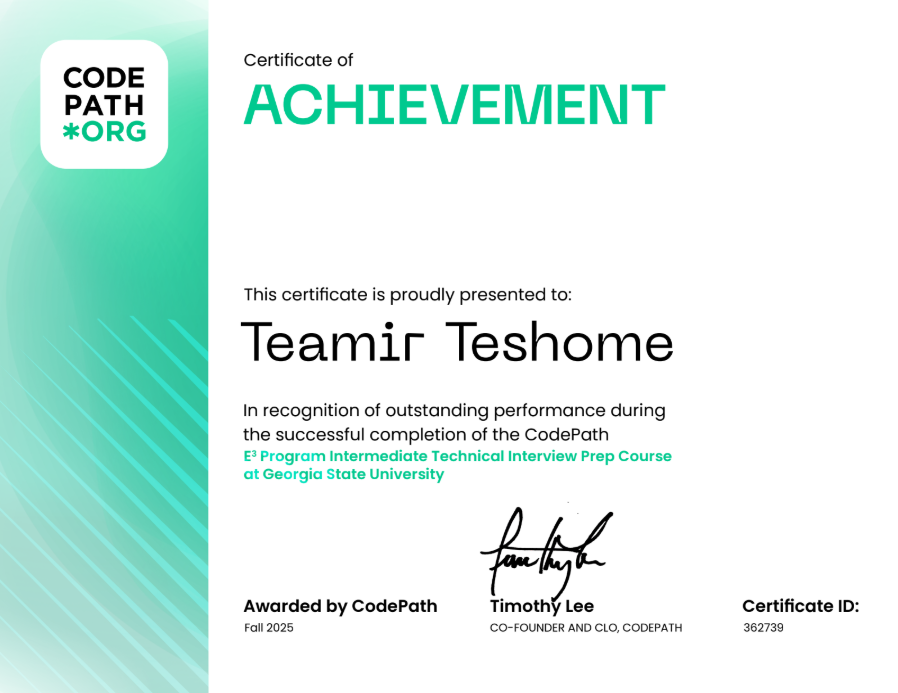
Intermediate Technical Interview Prep
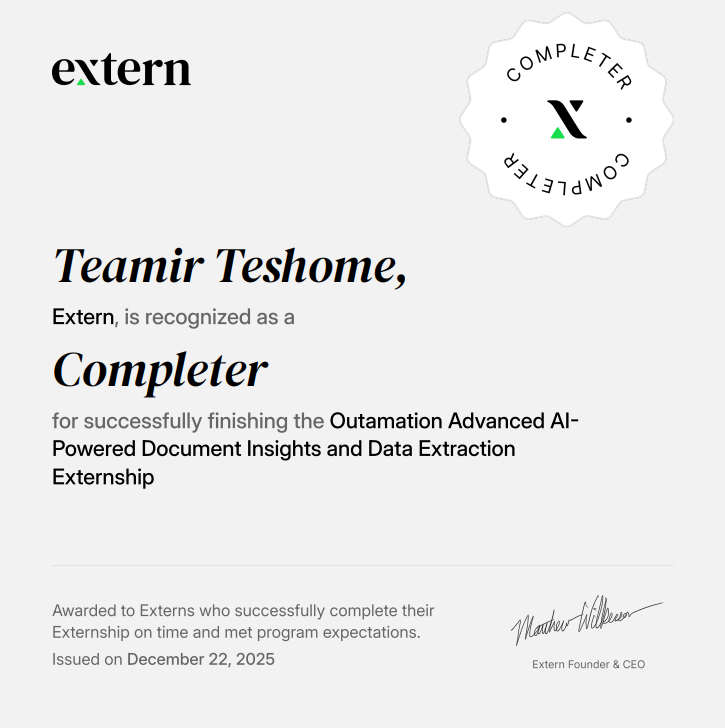
AI Document Intelligence Extern

Microsoft Azure AI Fundamentals
Grokking the System Design Interview
Github Certified Developer
Languages
- Python
- SQL
- C
- JavaScript
- HTML
- CSS
Frameworks/Libraries
- Flask
- FastAPI
- React.js
- Librosa
- PyTorch
- NumPy
- Pandas
- Matplotlib
Tools/Databases
- Git/Github
- Supabase
- MySQL
- PostgreSQL
- Google Cloud
- Azure
- OpenAI
- • AI + Systems Engineering
- • Full-Stack & ML Development
- • Applied Machine Learning
- • Backend Architecture & Performance
- • Systems Programming
Right now, I’m primarily locked in on software engineering, so I’m investing heavily in core SWE skills through things like a systems design certification, an AWS/cloud certification, and an upcoming SWE internship. At the same time, I’m intentionally building strong AI/ML fundamentals by joining two research labs and working on ML-focused projects, with the long-term goal of specializing in machine learning during graduate school. I see SWE as my foundation and AI/ML as my specialization, allowing me to bridge production-level systems with advanced machine learning rather than treating them as separate paths.